|
 |
From the earliest times the spinning wheel or Charkha had been plied in Indian homes, the excavation at Harappa and Mohan-jo-dare reveal that the charkha was a part of the Indian household. The Vedic Aryan also used the charkha.
The Buddhist age also the charkha continued to be plied. During the region of Mauryas, there existed a large organization to deal with matters connected with spinning and weaving. The spinners were women who did the work at home in their spare time. The entire process from picking of the raw cotton so carding, slivering, spinning and weaving was done by hand. It involved great skill and our textiles were unrivalled for their excellence. Foreign travelers like ‘Marco Polo’ (1288) and ‘Tavernier” (1660) wrote in details about the excellence of Indian cotton fabrics. In the Mughal period, hand spinning and weaving continued to be an important occupation. The fabrics were known for their exquisite beauty.
From the Sixteenth century, foreign traders i.e. the Portugese, the Dutch the French and the British had begun to come to India from the West. By the seventeenth century, the English traders set-up the East India Trading Corporation in English with the main object of importing Indian goods including textiles.
But the influx of Indian fabrics excited the jealousy of the weavers in England. The British Parliament passed an Act imposing excessive duties on cloth from India. It also imposed heavy penalties on the users of Indian fabrics in England. Afterwards, the British, lowered duties levied on English goods coming to India and imposed heavy duty even on inland transit on Indian products. As a result, India was flooded with cheap cotton goods from England where the adoption of mechanical invention gave the manufacturers an advantage over Indian weavers, which affected seriously the position of the Indian spinners and weavers.
|
| The background of Khadi |
in the last one half centuries can be split into following distinct phases, viz. I (1854 – 1920), II (1920 – 25), III (1925 – 35), IV (1935 – 44), V (1944 – 53) and the current phase (1953 onwards).
|
| PHASE – I (1854 to 1920) |
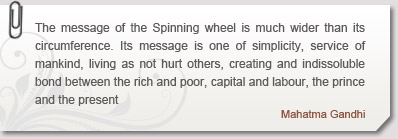
The first cotton mill of India was started in Bombay in 1854. The economic and cultural consequences of this event were disastrous. Due to sudden mechanization, the concept of wages and labour underwent a transformation and the dignity of the art of spinning and weaving of Khadi was lot. The contemporary social fabric of the rural areas disrupted severally. During Swadeshi movement, people were asked to boycott British goods. After 1905, the movement spread to the whole of the country. But, khadi was still not in vogue, and the handlooms worked with mill-spun yarn. Afterwards, in 1915, khadi came into its own. Gandhiji discovered in the spinning wheel, the panacea wheel, the panacea for India’s poverty and also the symbol of nation’s struggle for freedom. By 1921, khadi become a part of the national movement. In 1926, Gandhiji advocated khadi as the only true”Swadeshi”. He declared “Swadeshi” is the soul of “Swaraj”, Khadi is the essence of Swadeshi. The only Swadeshi cloth is ‘Khaddar’ because in the manufacture of it, millions of persons can participate. As the non-cooperation movement under Gandhiji progressed, the popularity of khadi increased. Khadi, become the livery of freedom. The spirit of khadi become synonymous with plain living and high thinking khadi become a symbol of the Nation’ will to labour and sacrifice and it stood for a new social order free from inequities and inequalities and also it upheld the principle of ‘bread labour’ i.e. the truth that man must live by the sweat of his brow.
|
| PHASE – II (1920 – 1925) |
Khadi was introduced in 1920 with a primary intention to make the boycott of foreign goods in general, particularly foreign cloths and provide an opportunity to every man, women and child for self discipline and self sacrifice as a part of the non-cooperation movement. However, this was linked with the necessity of finding work for spinner and weavers as a measure of relief from the evil of wide spread unemployment. In 1923, an All India Khadi Board under the supervision of the Indian National Congress, with branches in all States was constituted to create an organization for coordinated development of the khadi programme.
|
| PHASE – III (1925 to 1935) |
In 1925, an autonomous organization named the All India spinners Association or the Akhil Bharat Charkha Sangh was created. The AISA, till 1935, concentrated it’s activity on propagation, production and sale of khadi. Effort was made to adopt production to the requirements and tests of people in urban area. The technique of carding, spinning, weaving, dyeing and printing was considerably improved and new varieties of khadi were placed on the market. In 1933, 10 million sq. yards of cloth were produced and partial employment was estimated at 2 lakh persons. However, during this time, considerable expansion of demand led to the production of spurious khadi and steps had to be taken to counteract this un-wholesome practice. Gandhiji, however, continued to emphasize upon the village khadi, it’s style and durability to suit the taste of the villagers and create a better and more real bond between ginners, carders, spinners and weavers, on the one hand and khadi workers on the other. He emphasized that ‘khadi’ can be permanent only when it had obtained a permanent footing as a village wear.
During this period, production for sale in town and cities became the main pre-occupation of khadi workers. There was considerable expansion of production, techniques was improved, new varieties of goods were put in the market and an atmosphere for development was created.
|
| PHASE – IV (1935 to 1944) |
In the next two phases, social objectives became the primary object of consideration. Gandhiji raised the issue of giving the spinners ‘living wage’ i.e. the spinners family had to have the means for sustenance at a minimum level, i.e. minimum for maintenance of health of the family and the rates of wages have to be high enough to make it possible to earn his income for a full days work. In 1938, it was decided to introduce uniform wage chart of spinners. Besides the payment of standard wages, Mahatma Gandhi stressed the importance of other social objectives, like (i) self sufficiency, (ii) decentralization of production and consumption, (iii) establishment of a personal touch with the khadi workers and befriend them in all round economic development in their economic condition, (iv) Cultivation of cotton practically in every village without which khadi, according to Gandhiji, could never succeed.
|
| PHASE – V (1944 to 1953) |
In this phase, social significance and importance of khadi received a new and fresh emphasis a Gandhiji placed before the conference of workers convened in 1944, his views on the position and future of khadi. In his view, khadi, inspite of selfless work and sacrifice of many, had failed to achieve its object. The central theme of his new approach was that khadi could begin ‘to have permanent effect only when carried out as a part and parcel of the wider programme of non-violent age, uplift of village reconstruction – this he called “Samagra Seva” which meant work for re-organization of the entire rural economy on a new basis.
|
| Khadi after Independence |
After the attainment of independence in 1947, the AISA prepared an ambitious plan for meeting plan for meeting the clothing requirements of the country through hand spinning and hand weaving and at the same time, giving employment to large number of persons in rural areas. In the first five year plan, the planning Commission, recommended in view of the growing problem of unemployment, creation of a central organization which could give close attention to the problems of khadi and village industries and help create favorable conditions for action by State Governments constructive organizations and village cooperatives. The Government of India accepted the recommendations of the Planning Commission and in January 1953, the All India Khadi and Village Industries Board was set up. This Board took over the activity from the Akhil Bharat Sarva Seva Sangh in which the AISA was already merged earlier. Afterwards in 1957, a statutory body called the Khadi and Village Industries Commission was established by the Government of India under an act of Parliament, in order to overcome certain procedural difficulties which was hampering the progress of KVI programme. Even after the formation of the Khadi and Village Industries Commission, the Khadi and Village Industries Board continued to be an advisory board of this Commission.
|
|