|
 |
The Hand-spun hand woven cloth has been protecting the physique of the mankind ever since the dawn of human civilization. Of course in the golden days it was not called khadi, variety of cloth manufactured different places had their own specific features or special attractive. Rigveda, Ramayana, Mahabharat and many other holy scriptures have description of beautiful clothes produced by the spinners and weavers in those times. There is story in Mahabharat where the daughter of the king of Virat Nagar (where the pandavas spent a year of Agyatawas) requested her brother to bring the clothes of Kaurava worriers as gift for her after fighting out the battle with them. She was particularly keen to have the beautiful white clothes which Bhishma Pitamaha used to wear. The reference of cloth in this story tells us about the high skill of artisans of that period.
Till the onset of industrial revolution it was only hand spun hand woven cloth, which was used by the people all over the world. In the later part of 17th Century, when textile industry was fully mechanized, mill-made cloth took place of hand spun hand woven fabric. However, till 19th century, hand spun hand woven cloth was the popular fabric of the common man and mill-made cloth was confined only to the well-to-do class of the society.
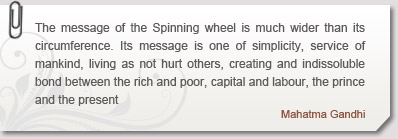
Weaving cloth on handlooms by village weavers for the local consumption was an essential part of self-sufficient rural economy in those days. The English traders who had established their rural in India by the middle of the 19th century understood the importance of this basic factor of rural economy. Therefore, they set upon a process of exporting raw material i.e. cotton from India which was connected into cloth in the textile mills of Manchester and Lancashire in England. Then the mill made cloth was imported in India for the consumption of our people. This process resulted in the large-scale unemployment of artisans in rural areas besides obliteration of the ancient art and crafts. Mahatma Gandhi, after his return from South Africa in 1915, understood the importance of hand spun hand woven cloth in national economy. So he conducted khadi programme as part of freedom struggle. Thus “Khadi”, a genetic name given to hand spun hand woven cloth is less than a century old but it had – existed throughout the history of mankind and protected us from the vagaries of weather.
Khadi is not merely a hand-spun hand woven cloth, but it is a great and rich heritage of mankind, which will continue to entice and enchant us in the times to come with all its melodies. The modern designers who have experimented with khadi cloth have all the praise for its five quality and various other attributes. Time has come when we desseminal the real message of khadi in order to make it a common man’s cloth rather than a fashion statement for the elite.
|
|